What is spaced repetition, and how do you use it?
Spaced repetition means reviewing something again just as you are starting to forget it, with the gap between reviews growing each time you remember it. It is one of the most efficient ways to keep a large number of words in long-term memory, and you can do it with paper cards or with an app.
Why it works
Two well-documented effects are behind it:
- Forgetting slows down with each review. Right after you learn a word you forget it quickly. Each time you successfully recall it, it lasts longer before it fades. That is why the gaps can keep growing: hours, then days, then weeks, then months.
- Spread-out practice beats massed practice. The same total study time spread over several sessions leads to better long-term memory than one long session. A large review of hundreds of experiments by Cepeda and colleagues (Psychological Bulletin, 2006) found this spacing effect again and again.
Spaced repetition adds one more ingredient: at each review you try to recall the answer before you see it. Recalling is harder than rereading, and that effort is what strengthens the memory.
What a schedule looks like
There is no single perfect schedule. Different apps and methods use different gaps. The idea is always the same:
- A new or missed word comes back soon: within hours or the next day.
- Each correct answer makes the next gap longer: a day, a few days, a week, a few weeks.
- A word you forget goes back to a short gap and climbs again.
So a word you know well costs you a few seconds every few months, and your time goes to the words you are still struggling with.
Spaced repetition on paper: the Leitner box
You don't need an app. A Leitner box is a set of boxes (or envelopes) for your cards:
- Box 1: new and missed cards. Review every day.
- Box 2: review every 2 to 3 days.
- Box 3: review once a week.
- Box 4: review every two weeks or so.
When you know a card, move it up one box. When you miss it, it goes back to box 1. The paper version works well; the main costs are writing the cards and remembering which box is due on which day.
Tips for making it work
- Review every day, even briefly. The method depends on seeing cards when they are due. Ten minutes a day is enough for many learners.
- Keep new words modest. Each new card adds reviews in the days that follow. If your reviews take too long, add fewer new words for a while instead of skipping reviews.
- Be honest when you grade yourself. Marking a half-remembered word as known pushes it out too far, and it will fade before you see it again.
- Use the words outside your reviews. Reading and speaking add natural reviews and show you how the words are really used.
How Laftel Lingo schedules your reviews
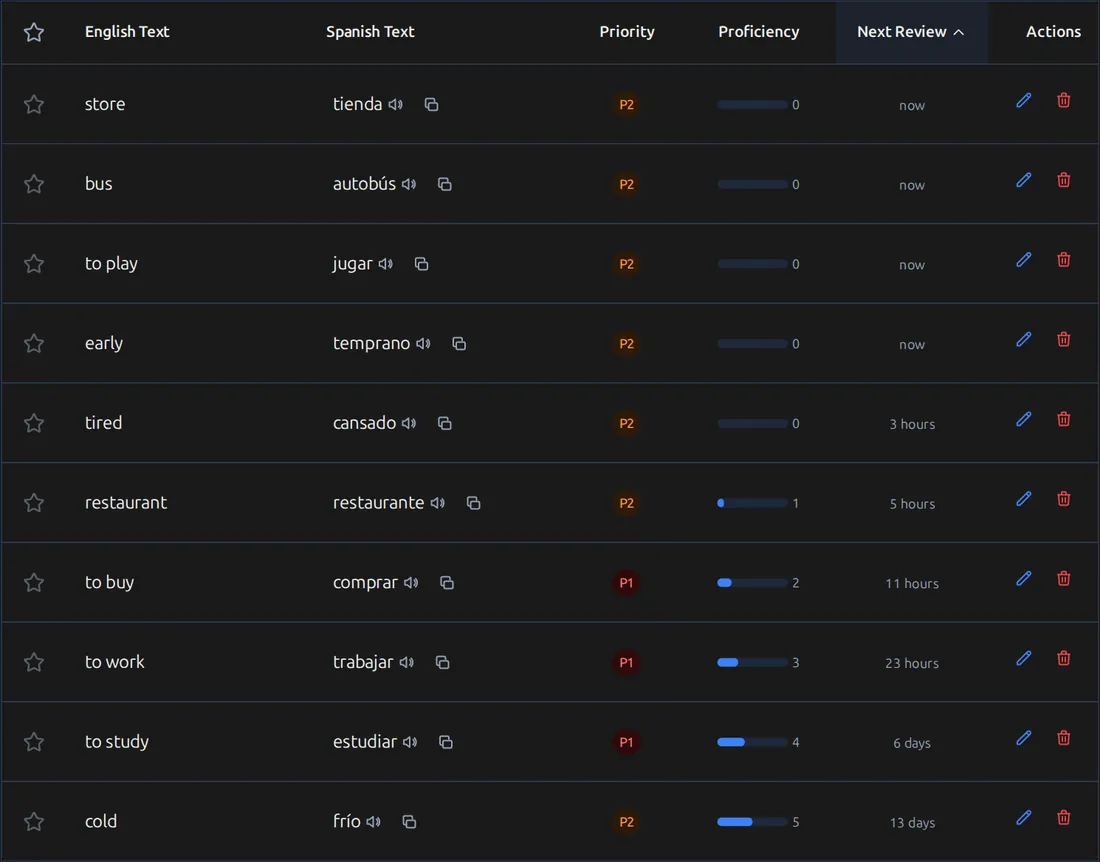
Laftel Lingo, a vocabulary flashcard app for web and Android, does the scheduling for you. Each card has a proficiency level from 0 to 10. Answering Know raises it by one, Don't know lowers it by one, and the level sets when the card is due again:
- Level 1: 6 hours
- Level 2: 12 hours
- Level 3: 1 day
- Level 4: 7 days
- Level 5: 14 days
- Level 6: 30 days
- Level 7: 90 days
- Level 8: 180 days
- Level 9: 365 days
- Level 10: mastered, no more scheduled reviews
A card you miss always comes back after 4 hours. The Manage view shows each card's level and when it is due next.
When nothing is due, Lingo keeps you practicing with cards that are not mastered yet, without changing their schedule, so extra practice never pushes a word out too far. Star a card to see it first in your next session.