How to memorize vocabulary in a new language
Short answer: learn words you will actually meet, test yourself instead of rereading, review each word again just as it starts to fade, and use it in a sentence of your own. None of this needs a special talent. It needs a small amount of steady practice.
1. Learn words you will actually meet
- Take words from your own life. A word you met in an article, a show or a conversation comes with a memory attached: where you saw it and what it meant there. A word from a random list has nothing to hold on to.
- Start with common words. Early on, the most frequent words pay off fastest because you will see and hear them again and again. Your textbook, your course or a frequency list is a good source.
- Learn short phrases, not only single words. "Hacía frío" (it was cold) teaches you the word, the verb that goes with it and the tense in one go.
2. Test yourself instead of rereading
Reading a word list again feels productive, but it mostly tells you the words look familiar. Trying to recall a word before you see the answer is harder, and that effort is what makes it stick.
This is one of the best-supported findings in memory research. In a study by Roediger and Karpicke (Psychological Science, 2006), students who practiced recalling a text remembered more of it a week later than students who spent the same time rereading it, even though the rereaders felt more confident.
In practice: cover the translation, say the word out loud, then check. If you got it wrong, that is fine. A failed attempt followed by the answer still helps.
3. Space out your reviews
Cramming twenty words in one evening works until the weekend. To keep them, come back to each word after a few hours, then a day, then a few days, then weeks. Each successful review lets you wait longer before the next one. This is called spaced repetition; see What is spaced repetition, and how do you use it? for how to do it on paper or in an app.
4. Give each word sound and context
- Hear it and say it. Listening to the pronunciation and repeating it gives you a second way to remember the word, and you will need it for speaking anyway.
- Read it in a sentence. Two or three short example sentences show how the word is really used: which preposition follows it, whether it is formal, what it is usually about.
- Make a picture for the stubborn ones. For a word that will not stay, invent a silly image or a sound-alike in your own language. Keep this for the few hard words; it takes too long for every word.
5. Use the words
Memorizing gets a word into your head; using it keeps it there. Write two sentences about your day with this week's words, say them out loud, or use them with a tutor or language partner. When you meet the word again while reading, you will notice it, and that is one more review for free.
Mistakes that slow people down
- Too many new words at once. New words come back as reviews later. A daily load you can keep beats a big start you abandon after a week.
- Long lists with no review plan. Words you never see again fade, however hard you studied them on day one.
- Only one direction. Recognizing "temprano" when you read it is easier than producing it when you want to say "early". Practice both.
Doing this with Laftel Lingo
Laftel Lingo is a flashcard app for web and Android built around the steps above. It does not replace reading, listening or speaking; it handles the part where you collect words and review them on time.
- Collect words from what you read. Paste a text (or upload a .txt, .pdf or .json file) and Lingo picks out up to 25 words at your level, skipping words you already have, with three example sentences each. You can also type a single word or phrase, or ask for a theme such as "10 popular fruits".
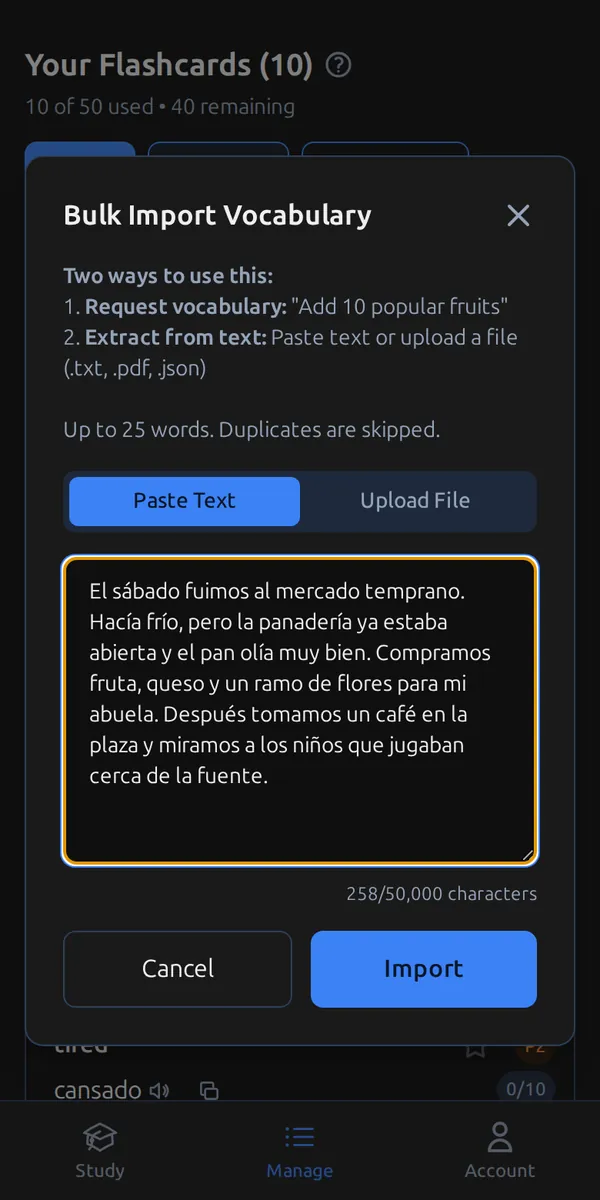
- Test yourself. Each card shows one side; you try to recall the other, then tap to check and answer Know or Don't know.
- Reviews come back on a widening schedule, from hours to days to months, and a word you miss comes back sooner.
- Hear every word and open its example sentences on the card.
It supports ten languages, including Spanish, French, German, Japanese, Korean, Mandarin and Arabic, and adds romanization (such as pinyin or romaji) where the script needs it.