How to use flashcards for language learning
Flashcards work well for vocabulary when you use them to test yourself, not to reread. Keep each card small, try to answer before you flip, study in both directions, review on a schedule and keep the number of new cards per day modest. Here is how, step by step.
What to put on a card
- One word or short phrase per card. "Temprano: early" is a good card. A card with five meanings and a grammar note is hard to answer honestly.
- Your language on one side, the new language on the other. Add the reading or romanization for languages with another script (for example pinyin for Mandarin or romaji for Japanese).
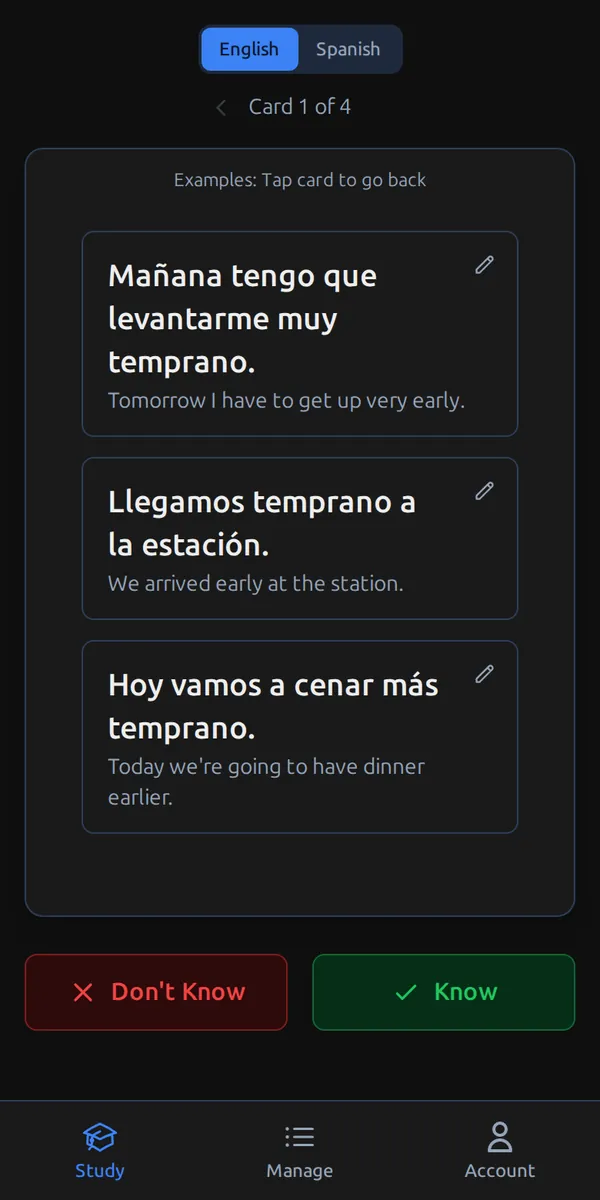
- Add an example sentence. A short sentence shows how the word is used and gives you something to picture. "Llegamos temprano a la estación" (we arrived early at the station) is easier to remember than "temprano" on its own.
- Add the sound if you can. You will need the pronunciation for speaking, and hearing the word gives you one more way to remember it.
How to study a card
- Look at the front and answer first, out loud or in your head. Don't flip until you have a real answer or you are sure you don't know it.
- Flip and check. Be honest: close enough counts, a guess that happened to be right doesn't.
- Sort it. Cards you knew can wait longer before you see them again. Cards you missed should come back soon, the same day.
- Say it once more. After a miss, read the answer aloud and look at the example. Then move on rather than staring at it.
The effort of recalling is the point. Recognizing a word when you see the answer feels like knowing it, but only recall tells you whether you can use it.
Study both directions
Seeing "early" and producing "temprano" is harder than the reverse, and it is the direction you need for speaking and writing. A simple routine: learn new cards from the new language to yours first, then switch to your language first once they feel easy.
Review on a schedule
Flashcards pay off when each card comes back at the right time: soon after you miss it, and at longer and longer gaps once you know it. On paper, a Leitner box does this with a few boxes you review at different intervals. In an app, the schedule is done for you. Either way it is called spaced repetition; What is spaced repetition, and how do you use it? explains how it works.
How many cards a day?
There is no single right number. What matters is that you can keep it up. Every new card brings reviews on the following days, so a session that feels light on day one gets heavier by the end of the week.
- Start small, for example five new words a day, and see how long your reviews take after a week or two.
- Do your due reviews before new cards. Reviews protect what you already learned.
- Ten minutes every day beats an hour on Sunday. Short daily sessions fit the schedule better.
Common mistakes
- Flipping too fast. If you flip before you try, you are rereading, not testing.
- Making cards for words you will never use. Pick words from your course, your reading and your own conversations.
- Keeping only the flashcards. Cards get words into memory; reading, listening and speaking make them usable.
Flashcards in Laftel Lingo
Laftel Lingo is a vocabulary flashcard app for web and Android. You type a word or phrase and it fills in the translation, romanization where needed and a priority; paste a text and it picks out the words for you. Example sentences are one tap away on every card.
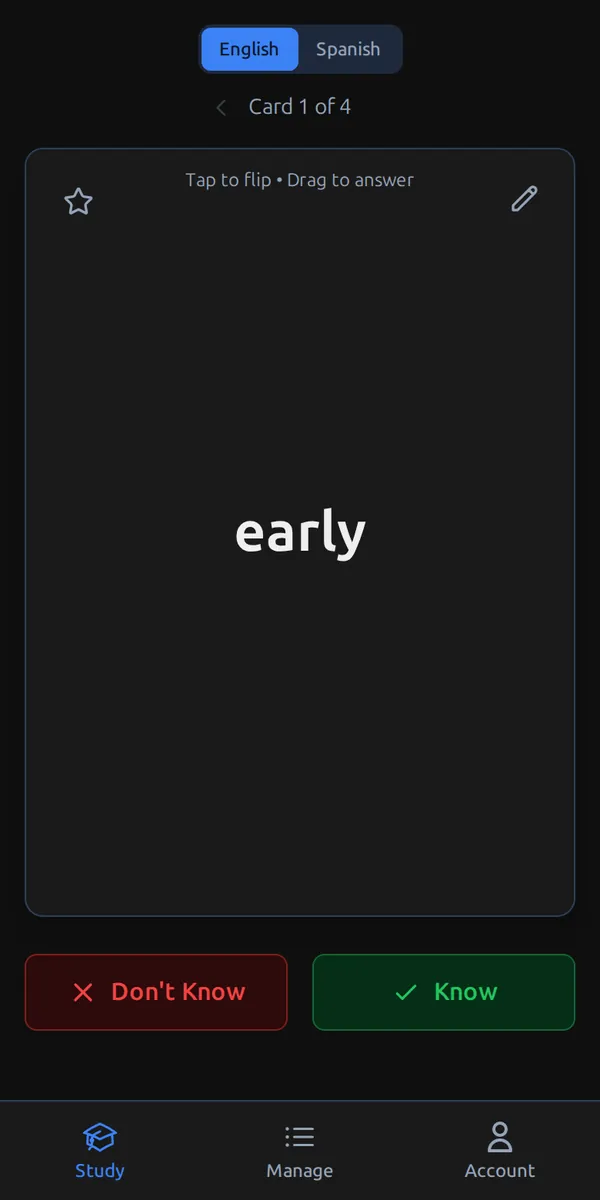
- Recall first, then flip. Tap the card to see the answer, then swipe right or tap Know if you got it, swipe left or tap Don't know if you didn't.
- Both directions. A toggle switches whether your language or the new language is on the front.
- Sound and examples on every card. Hear the pronunciation, or open three example sentences with their translations.
- Starred cards come first, for the words you want to practice today.
- The schedule is automatic. Each answer moves the card's next review: a miss brings it back within hours, a correct answer pushes it further out.
New language pairs start with ten ready-made cards, so you can try it before adding your own words.